
SSB
How to Get Screened In at the SSB
What actually matters on Day 1 of the SSB, from someone who has been through four: the OIR, writing the PP&DT story, listening, speaking in the discussion and body language.
DefenceRoger Editorial · 2 August 2026 · 7 min read
On this page
- Why listen to me
- What Day 1 looks like
- The OIR test
- Writing the PP&DT story
- A structure that works
- 1. The introduction
- 2. The main story
- 3. The ending
- Keep it realistic
- You don't need to be Shakespeare
- Listen to the instructions
- Speaking: the biggest factor
- Body language
- Practise the whole thing
- Is coaching worth it?
- To sum up
'How do I get screened in?' is the question I get asked most. So let me be upfront: I think screening is roughly half preparation and half luck. That isn't my line. An officer who used to work as a psychologist at a board told me that. You can't do anything about the luck part. This article is about the other half.
Why listen to me
I don't know everything about the SSB. But I have been to four: two for NDA, one for TES and one for the Navy technical entry. I was never screened out, and I was recommended three times. I'm not at the academy right now because of a medical reason, and I'd like to help others avoid the Day 1 mistakes that send good candidates home.
What Day 1 looks like
As of August 2026, a few centres have moved the OIR test onto computers and changed some small steps. Most still follow the usual order: the Officer Intelligence Rating (OIR) test first, then the Picture Perception and Discussion Test (PP&DT). It helps a lot to know how each of these is judged.
The OIR test
There are two booklets of reasoning questions, verbal and non-verbal, with about 50 questions each and roughly 30 to 35 minutes per booklet. Some centres now do it on a computer, but it tests the same thing: basic reasoning under time pressure.
Many people think the OIR score alone decides screening. From what an SSB officer told me, it doesn't. Unless your score is very low, it is a supporting factor and only a small part of the decision.
A good OIR score helps, but it rarely makes up for a poor showing in the PP&DT discussion.
Writing the PP&DT story
A lot of candidates work only on speaking and forget about the written story. Speaking in the discussion does carry more weight, but the story counts too. If you sometimes stammer or get nervous in front of a group, a well-written story gives you something solid to stand on. It won't fully cover for poor speaking, but it shows how you think.
A serving Army officer who had worked as an Interviewing Officer once explained to me how stories tend to be read, and even showed me the kind of margins they mark. That is not an official marking scheme and it may differ from board to board. Still, his advice on writing stories has stayed with me, and it's what I share below.
A structure that works
Don't try to write something extraordinary. You aren't writing a novel. Keep it simple and in three parts:
- Introduction: about 2 lines
- Main story: about 5 to 8 lines
- Ending: 1 or 2 lines
1. The introduction
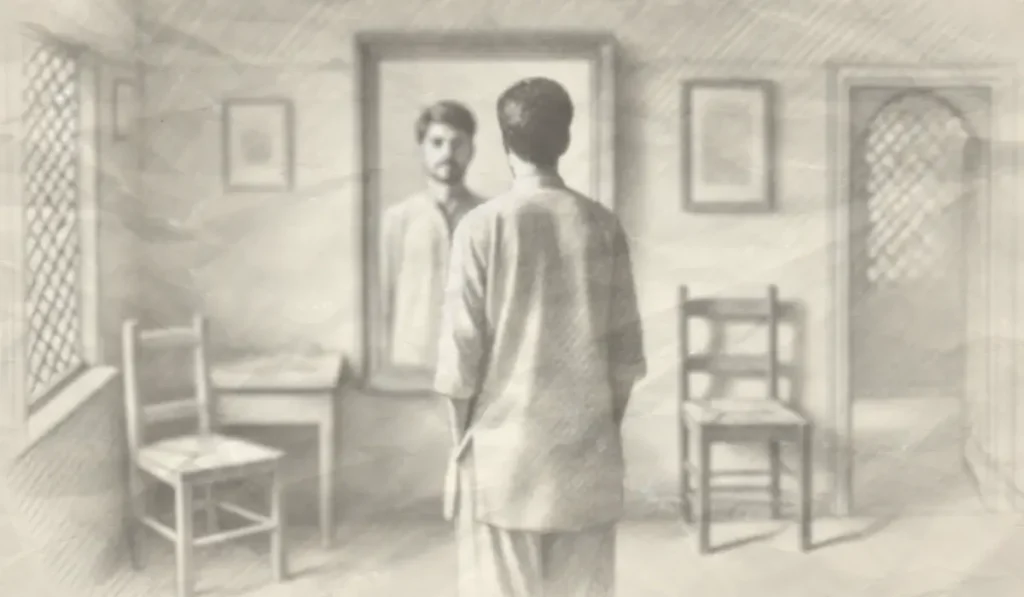
Say you are shown the picture above. Your first two lines should just set the scene from what you see: who the main character is and where they are. No complicated plot. Two lines is enough. More wastes time, and less may not explain the situation.
I might start like this: 'Sohan, who lives in Delhi, visited his ancestral village after many years. Curious about village life, he decided to wear a dhoti-kurta for the first time.' That's all. Two plain lines that set things up.
2. The main story
The next five to eight lines say what happens next. The easiest way to make it sound natural is to borrow from your own life. Change the names and details, and fit something that happened to you onto the picture.
I have never worn a dhoti, but I have worn a kurta-pyjama. So I can write about Sohan feeling awkward at first, getting used to it, talking to the villagers and enjoying the day. These are ordinary things, and that's exactly why they sound true.
A simple story that sounds real almost always beats a dramatic one.
3. The ending
Close with one or two lines that finish the situation. Don't bring in a new event at the end. Just say how it turned out or what the character took away from it.
Keep it realistic
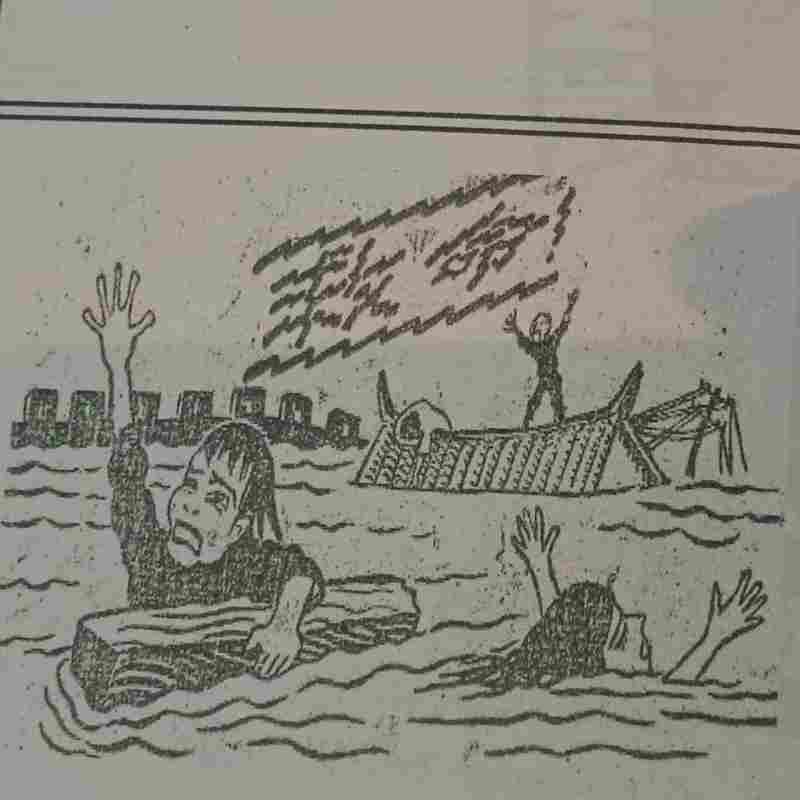
Look at this second picture. Say it shows a girl drowning and a boat close by. Many candidates jump straight into a heroic story. That isn't what the assessors want. They want practical thinking and common sense.
A practical story would have the main character take the boat, throw her a rope or a life jacket, pull her out, and then get help if needed. That shows presence of mind.
Compare that with a hero who dives into deep water, carries the girl on his shoulders and swims back without using anything around him. In a real emergency that wastes time and puts both of them at risk. Practical beats filmy, almost every time.
You don't need to be Shakespeare
Nobody is marking your literature. They want to see how you think. Whether the story comes from your life or your imagination doesn't matter, as long as it is logical, believable and easy to follow. Simple words, a clear order of events and a positive ending will do more for you than fancy writing.
Listen to the instructions
This one gets ignored a lot. Before every stage the officers brief you. Most of it is the same everywhere, but some details change from centre to centre, and missing them makes a poor first impression.
At my first SSB, the officer clearly said that nobody should stand up while narrating during the PP&DT discussion. One candidate either missed it or ignored it and stood up anyway. The officer pointed it out in front of everyone. He did get screened in in the end, but everyone noticed he hadn't been listening. Pay attention whenever you are being briefed.
Speaking: the biggest factor
In my experience, the biggest thing that decides screening is how well you communicate in the group discussion. I said communicate, not speak perfect English.
You don't need to sound like a native speaker. You need to get your ideas across clearly and confidently enough that the people around you understand them. Be audible without shouting, keep a steady pace and don't rush.
Plenty of capable people get screened out because they never managed to put their point across in the discussion. The assessors can only judge what you show them, not what you were thinking.
Body language
It isn't only words. Sit straight, keep your hands relaxed in your lap, stay composed and don't fidget. When an officer is briefing you, look at the officer. Smile when it fits. It doesn't need to be perfect. It just shows you are at ease.
Practise the whole thing
This is the most neglected part of preparation. People read about psychology tests, GTO and interview questions, and never once practise talking in a group of 10 to 15. A PP&DT discussion feels completely different from speaking alone.
The more you practise discussing stories with a competitive group, the more natural it gets. You learn when to come in, how to make your point without cutting people off, and how to stay calm when it gets noisy.
Is coaching worth it?
That's your call. I think it helps many people, not because coaches know secret tricks, but because you get to repeat the PP&DT setting again and again with other aspirants.
Even after I had been recommended, I joined coaching again before another attempt, just for the practice. The repeated discussions made me more comfortable and confident.
Can you get recommended without coaching? Of course. Lots of people do every year. But if group discussions make you nervous, regular practice with others can make a real difference to how much of yourself you are able to show.
To sum up
Screening isn't designed to throw out good candidates. It is there to find people who can show officer-like qualities in a very short time. Sadly, a lot of good candidates don't manage to show what they have and go home on Day 1.
Work on what you can control. Practise OIR questions regularly, listen to every briefing, speak clearly, sit and stand confidently, and above all practise speaking in a group. You can't remove the luck, but you can make sure that when the moment comes, you are ready for it.